
Why Email Marketing for Education Companies Fails with District Leaders (and How to Fix It)

Email marketing for education companies and K-12 vendors often fails for a simple reason: It’s written for inboxes, not for the district leaders actually making decisions.
Marketing to district leaders is fundamentally different from other industries. These are risk-averse, time-strapped buyers who rely heavily on peer referrals and real-world proof.
If your email doesn’t reflect that reality in the first few lines, it’s unlikely to get read at all.
The problem with most education and edtech email campaigns isn’t the product, the design, the send time, or the subject line. It’s that the emails aren’t written for the person reading them. They’re written for an inbox.
Here are the five mistakes we see most often, and what to do about each one.
Mistake 1: Writing for Inboxes, Not People
Most education company emails follow the same template: state a problem, name the product, include a CTA. The formula is so familiar and generic that district leaders often click “delete” before reaching the end.
A superintendent opening your email on a Tuesday morning isn’t thinking about your platform. She’s thinking about the board meeting Thursday, the “no more screens” debate happening in the town Facebook group, and whether last year’s curriculum rollout is going to create friction in next year’s budget. Your email interrupts that thought spiral. The question is whether it speaks to what’s already in her head or ignores it entirely.
Consider this line, pulled from a real campaign:

The instinct is right: signal insider knowledge, earn trust. However, the execution reads like a tagline. What schools? What did you learn there?
The Fix
Open with a specific, true observation about what district leaders are navigating right now: budget cycles, board pressure, or initiative implementation fatigue after a difficult rollout year. Earn the pivot to your product. Give them 30 seconds of “this person gets it” before you ask for anything.
Mistake 2: Asking for Trust Before Building It
Education is a referral-driven industry. When something goes wrong in a district—a failed implementation, a tool teachers won’t use, a parent backlash—it goes wrong loudly and publicly. That reality shapes how district leaders buy. They call peers, check state listservs, and text colleagues at neighboring districts before they consider a vendor.
Your email can accelerate that trust-building process.

Which districts? In what state? What did their curriculum director say six months after go-live? For a risk-averse buyer, anonymous social proof doesn’t move the needle. It signals that you either don’t have referenceable customers or don’t think specifics matter, and either reading is damaging.
The Fix
Add one real reference point to every cold email, like a district name if you have permission or a title and region if you don’t (e.g., “a curriculum director in a mid-size Texas district). If you can segment by state and include state-based testimonials, even better. Specificity always wins.
Mistake 3: Sounding Like A Vendor, Not A Partner
The most common format in edtech email is a bulleted list of three to five pain points paired with three to five product features. It reads like a spec sheet dressed as an outreach email, and it’s been done so many times that the format itself triggers skepticism before the recipient has read a word.
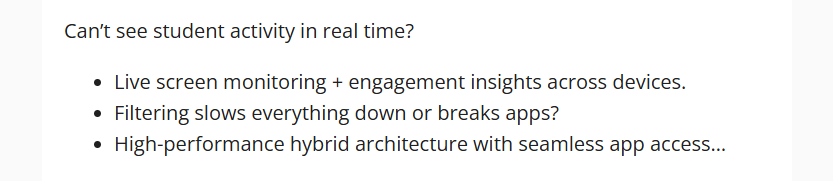
The pain points are real. The solutions are probably good. But stacking five of them in parallel bullets signals that a product manager wrote this, not someone who knows what it feels like to make critical decisions that affect hundreds, even thousands, or children. It also forces the reader to do the work of deciding which problem applies to them. Most won’t bother.
The Fix
Pick your single strongest pain point that you know appeals to your target audience. Write three sentences about it in plain language (the kind you’d use talking to a colleague, not presenting to a board). Then introduce how you solve it. One problem, one solution, one story.
Mistake 4: Weak Subject Lines in K-12 Marketing
Pull up the last five subject lines you sent. Ask yourself honestly: Could any competitor in any industry have written these?
“Set Your Organization Up for Success Before Fiscal Year-End” could have come from a payroll company or a financial advisor.
“[GUIDE] Safer, More Accountable Student Behavior” leads with a format label instead of a reason to open.
“MIT Study: Most Companies Are Failing at AI Implementation” has nothing to do with education, and a district leader will feel that disconnect in two seconds.
Now compare those non-examples to:
“The closest thing to getting inside your students’ heads.”
That one gets opened. It speaks directly to something an educator actually thinks about. The others were written for anyone. District leaders can tell and click “open” accordingly.
The Fix
Rewrite your subject lines with one specific detail that only makes sense for an education audience, such as a real challenge, a real moment in the school year, or a real question your buyer is sitting with right now. Summer, for instance, is one of the best windows to reach district leaders: Inboxes thin out, budgets have been set, and the people making decisions actually have time to read and think. A subject line that speaks to that moment (“What are other districts planning before August?”) will outperform a generic one every time.
Mistake 5: High-Friction CTAs in Education Sales
The default edtech email CTA is a demo request. “Book a call.” “Schedule time with our team.” These are reasonable asks from buyers already in consideration. Sent cold, they ask someone who doesn’t know you yet to make a calendar commitment based on a single email, and that’s a big, unlikely lift.

This CTA might work for attendees already walking the conference floor. For everyone else on the send list, it’s asking a cold prospect to take a meaningful step based on nothing. There’s no resource, no insight, no reason to engage short of full buying intent.
The Fix
Replace your cold-email demo CTA with a low-commitment offer. “I put together a one-page breakdown of how three similar districts approached this. Want me to send it over?” That’s an easy “yes.” It starts a conversation and positions you as a resource before you’re ever a vendor.
How to Improve Your Edtech Email Marketing Strategy
None of these mistakes will sink your email marketing on their own. But together, they almost guarantee your message gets ignored.
Marketing to district leaders isn’t about better templates, catchier subject lines, or more polished design. It’s about showing that you understand how schools make decisions. These are relationship-driven, risk-aware buyers who don’t respond to generic outreach or abstract value propositions.
The edtech companies that win are the ones who sound like they’ve been in the room by reflecting real budget pressures, real implementation challenges, and real conversations happening in K-12 districts.
If your email marketing isn’t getting the traction you want, start by focusing on one real problem, one specific audience, and one credible proof point. That is how you turn cold outreach into real conversations and real conversations into leads.
If you’re unsure where your emails are missing the mark, Ed2Market can help. We work exclusively with edtech and education companies to refine messaging, align with district buying behavior, and build email strategies that actually get responses. Reach out and we will give you a clear, honest read on what is working and what is not, or check out our marketing playbook for six steps you can take to stay ahead of the competition and ensure your products and services are seen, heard, and contemplated by school and district leaders.
Last updated: April 9, 2026
Author Name: Katie Stoddard
Katie Stoddard is the President and Founder of Ed2Market. With a background in teaching and 15+ years in education marketing, she helps brands connect with schools and educators.